
Can Better Programming Unlock Improved Outcomes in Hypoglossal Nerve Stimulation?
LivaNova’s PolySync Data Suggests It Can


Why do some patients receiving hypoglossal nerve stimulation fail? This is a loaded question. Success is based on a variety of sleep study, patient subjective, and use metrics. But one thing is for sure: the implant is only the beginning of the journey. Programming, ongoing follow up, titration, and monitoring are essential for true ‘success.’
The first aspect of this is getting increased attention. At the SLEEP 2026 meeting, LivaNova presented interesting data regarding their new PolySync programming, as part of the OSPREY study. What did it show? And what does it mean for surgeons and the field moving forward?
A Quick Refresher: The OSPREY Trial
OSPREY is LivaNova’s randomized controlled trial evaluating the aura6000™ proximal hypoglossal nerve stimulation (pHGNS) system for adults with moderate-to-severe obstructive sleep apnea who are unable to tolerate CPAP.
Unlike currently available unilateral hypoglossal nerve stimulation systems, the aura6000 stimulates the hypoglossal nerve more proximally, with the goal of recruiting multiple tongue muscle branches through a circumferential cuff with 6-electrodes along its length.
The previously reported 12-month OSPREY data demonstrated:
65% responder rate using standard Sher criteria
Significant improvements in AHI
Improvements in oxygen desaturation index (ODI)
Favorable safety profile
These results established proof-of-concept for proximal hypoglossal nerve stimulation, and led to its recent FDA approval.
What Is PolySync?
Every clinician who manages hypoglossal nerve stimulation has encountered the same challenge: not every patient responds optimally to initial programming.
Historically, optimization has relied on adjusting stimulation amplitude, pulse width, frequency, or selecting different electrode contacts individually.
PolySync introduces another option.
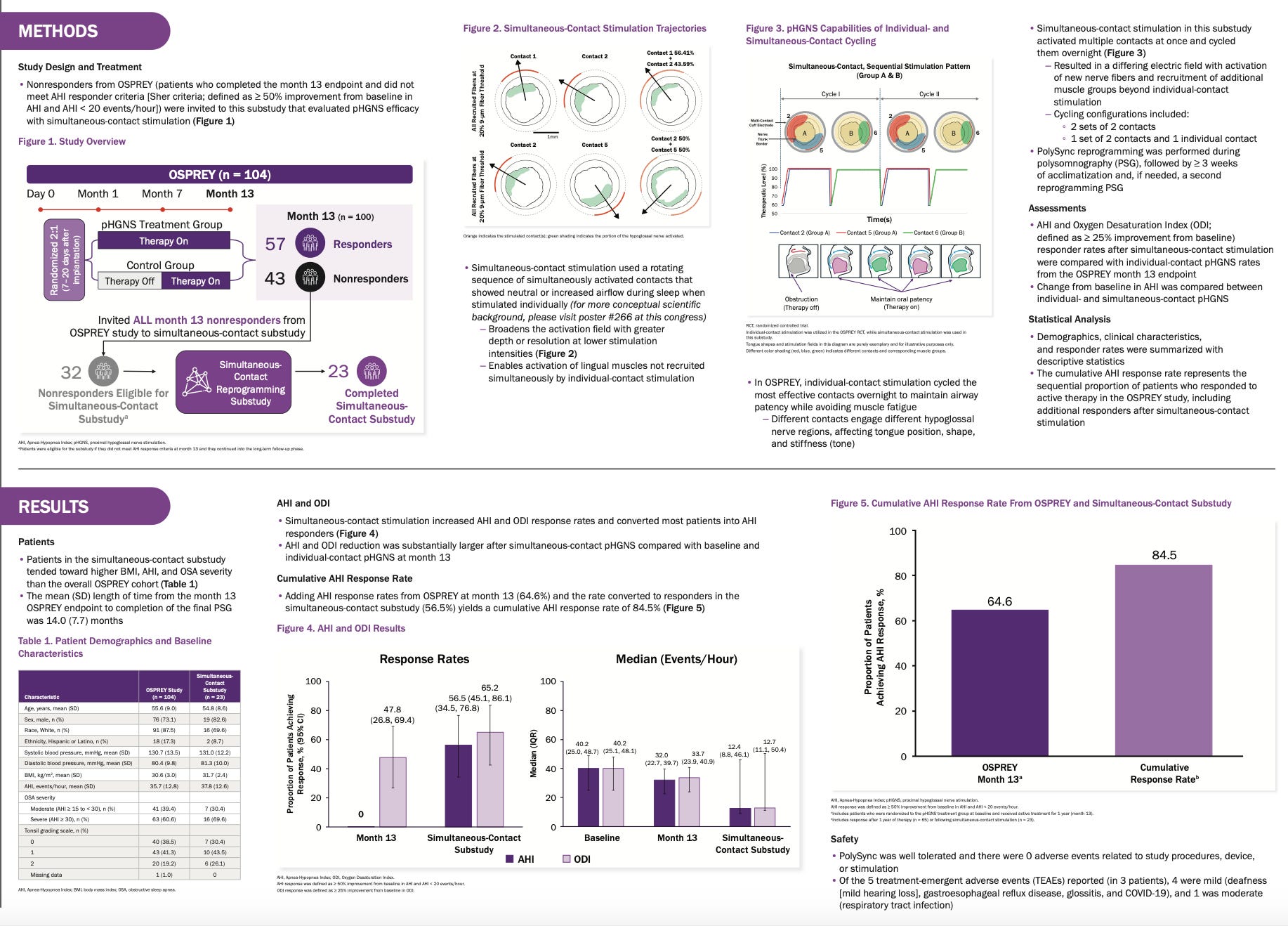
Rather than stimulating individual electrode contacts independently, PolySync allows simultaneous-contact stimulation, creating additional stimulation patterns that may recruit the hypoglossal nerve differently.
Think of it as expanding the programming “toolbox.”
Instead of accepting a patient as a non-responder after standard programming, clinicians gain additional programming strategies that may better match an individual’s nerve anatomy and physiology.
The New Data
The PolySync substudy focused specifically on patients from OSPREY who did not meet responder criteria with conventional individual-contact programming at month 13 of the study. Note: This included some patients from the initial control group until month 7 of the study.
These patients underwent reprogramming using simultaneous-contact stimulation.
The results were notable. Most initial nonresponders converted to responders after PolySync optimization.
The cumulative response rate increased from approximately 65% to 84.5% (reported as 85%) across the OSPREY treatment cohort.
In addition to improved responder rates and AHI, investigators also reported improved oxygen desaturation index (ODI). Importantly, no additional surgery was required. These improvements were achieved simply through programming.
Why This Matters
This builds on a broader shift in how we think about implantable therapies.
Historically, discussions around HGNS have focused heavily on hardware:
Electrode design
Implant location
Respiratory sensing
Surgical technique
But increasingly, surgeons and clinicians are emphasizing the importance of programming, adjustments, and follow-up to success in surgical outcomes. This mirrors many other implant therapies (vagal nerve, etc.) and speaks to a maturing of our market. Whether this is due to LivaNova having additional nerve stimulation experience in their portfolio, or time adjusting providers’ expectations and guidance, hard to say.
Regardless, rather than viewing implantation as the end of treatment, we now emphasize to patients implantation as the beginning of an ongoing optimization process.
Looking Beyond Short-Term Response Rates
An 85% cumulative response rate naturally attracts attention. However, another implication may be even more important.
As more hypoglossal nerve stimulation platforms enter the market—including bilateral systems, proximal stimulation, and additional nerve targets—the conversation may increasingly shift away from which device is implanted toward how effectively that device can be programmed over time. Most importantly, what are the true long-term efficacy data, tolerance/adherence data, etc.
Programming flexibility could become an important differentiator between platforms.
Future innovation may involve:
AI-assisted programming
Automated titration algorithms
Physiologic feedback during stimulation
Closed-loop systems that dynamically adjust therapy throughout sleep
Final Thoughts
The field of sleep surgery is evolving rapidly.
The PolySync findings suggest that significant improvements in clinical outcomes may still be achievable without changing the implant—simply by changing how the nerve is stimulated. As with adjustments to Inspire, this reiterates the importance of programming to success.
For clinicians, this reinforces the importance of long-term follow-up and thoughtful device optimization.
For patients, it offers another reminder that an initial suboptimal response may not be the final answer.
As more data emerge and additional platforms enter clinical practice, expect programming—and personalization—to become increasingly central to the next generation of hypoglossal nerve stimulation.
Best, Chris & Robson.
"As more hypoglossal nerve stimulation platforms enter the market—including bilateral systems, proximal stimulation, and additional nerve targets—the conversation may increasingly shift away from which device is implanted toward how effectively that device can be programmed over time."
AI-enabled programming will come with an even greater regulatory burden, right? Are you aware of any primers, commentaries, or resources to dig into this side of things from a sleep medicine standpoint?