
Philips Respironics is Returning to CPAP
What Should Clinicians and Patients Expect?


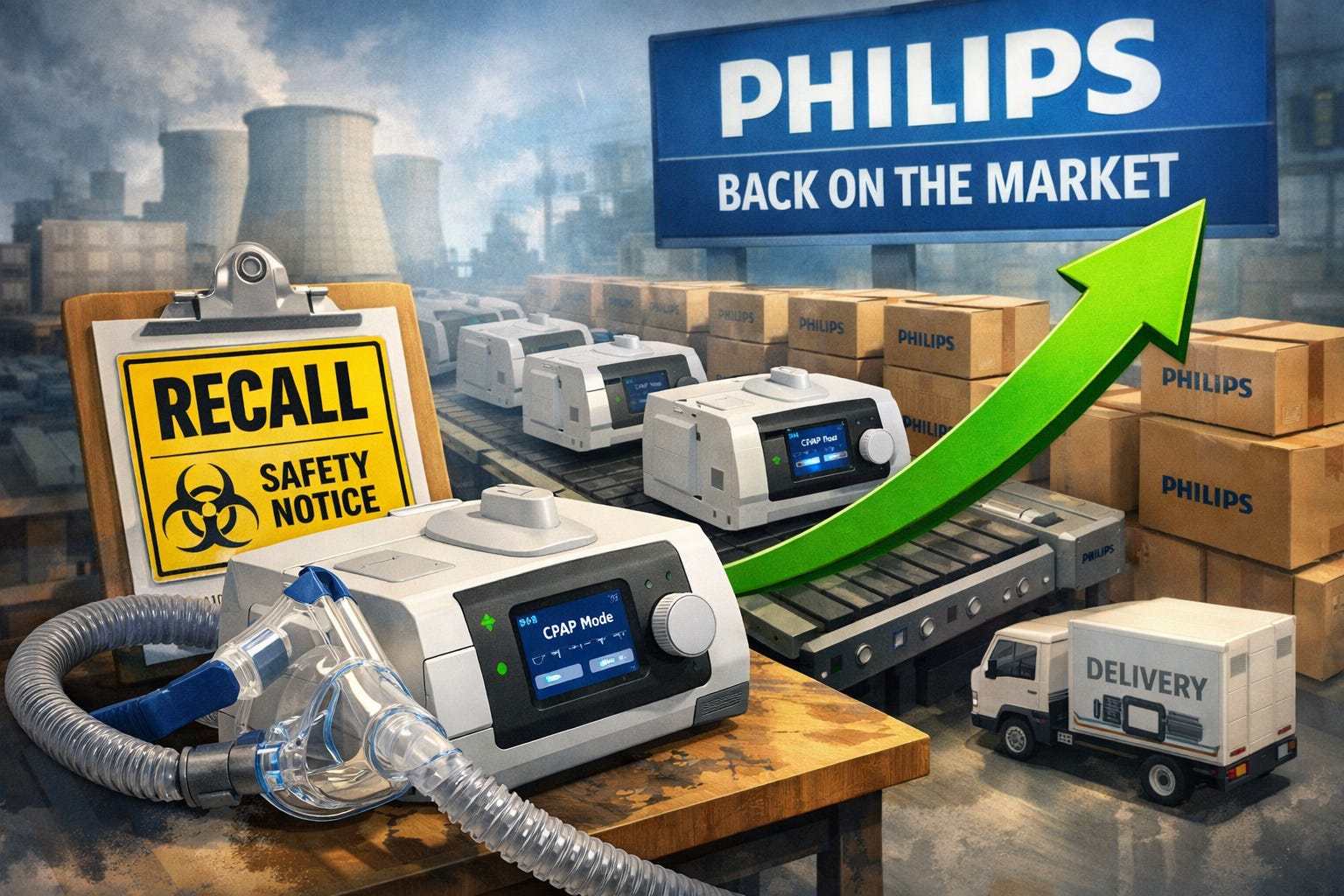
For decades, the global positive airway pressure (PAP) market rested on three pillars: ResMed, Philips Respironics, and Fisher & Paykel. Then in June 2021, one of those pillars abruptly fractured.
The Philips Respironics recall—triggered by degradation of polyester-based polyurethane (PE-PUR) foam inside millions of CPAP, BiPAP, and ventilator devices—became one of the most consequential events in sleep medicine technology.
Now five years later, Philips is planning a return to the CPAP market? What can patients, clinicians, and the broader market expect?
The Recall That Reshaped PAP
The scope of the 2021 recall was unprecedented:
Millions of devices globally affected
FDA Class I designation (highest risk)
Reports of foam particle inhalation and volatile compound exposure
Hundreds of adverse event reports and deaths investigated
Philips ultimately halted U.S. sales of CPAP and BiPAP devices in 2024 as part of a consent decree with the FDA and Department of Justice.
Even today, remediation has been massive and prolonged—over 2.5 million devices repaired or replaced, with programs only recently closing to new registrations.
The practical result for clinicians: a durable supply shock that reshaped prescribing patterns and vendor relationships across sleep medicine. And for many patients, real frustration and anger.
A Market Gap That Hasn’t Fully Closed
In the years since the recall:
ResMed captured substantial global share
Fisher & Paykel expanded mask and device adoption
New entrants have gained attention
Durable medical equipment (DME) providers diversified suppliers
Yet many clinicians still describe the PAP market as less competitive than before 2021.
That matters. PAP therapy remains the gold-standard treatment for obstructive sleep apnea (OSA), and the global sleep apnea device market is projected to grow steadily through the next decade with rising diagnosis rates and aging populations.
In short: demand expanded just as one of the historic “big three” disappeared.
Regulatory Reality: Why Re-entry Takes Time
The consent decree between Philips and U.S. regulators created a structured pathway—but also significant constraints.
Philips can currently:
Service existing devices
Sell accessories and replacement parts
Export certain products
But restarting U.S. CPAP sales requires demonstrating sustained compliance across manufacturing, quality systems, and post-market surveillance.
These processes in the medical device industry typically take 5–7 years to complete.
That timeline aligns with the recall chronology:
2021 — recall announced
2024 — U.S. sales halted
~2026–2028 — plausible window for normalized U.S. re-entry
In other words, a return is expected—but not imminent.
What Will Philips Re-entry Look Like?
When Philips does return meaningfully to the U.S. CPAP market, several characteristics are likely.
1. Safety-first device redesign
Philips has already shifted from PE-PUR foam to silicone-based materials and reports extensive testing without safety issues.
Expect:
Transparent materials disclosure
Heavier regulatory documentation
Trust rebuilding will be central.
2. Quality-system–driven rollout
The consent decree forces Philips to demonstrate sustained manufacturing and quality performance before full commercialization.
Clinically, that likely means:
Gradual launch
Limited initial distribution
Close FDA monitoring
Potential staged product portfolio
3. Competitive pricing pressure
One of the most immediate impacts of Philips’ absence was pricing power shifting toward remaining vendors.
A Philips return would likely:
Increase DME negotiating leverage
Expand payer contracting competition
For sleep clinics and patients, this could be positive.
4. Technology repositioning
Philips historically positioned itself as:
Clinician-friendly
Feature-rich
Patient-comfort oriented
A relaunch may lean heavily into:
Digital adherence ecosystems
Telemonitoring
Patient engagement platforms
Market Expectations: Why the Industry Is Watching
From a market perspective, Philips remains structurally important:
One of the historic global PAP leaders
Massive installed base
Established DME relationships
Strong brand recognition among clinicians
Even after the recall, Philips sleep & respiratory care still represents a multibillion-euro segment within the company.
The industry expectation is not whether Philips returns—but how quickly share can be regained once allowed.
The Clinician Question: Will Trust Return?
Perhaps the most important uncertainty isn’t regulatory—it’s clinical.
Sleep clinicians now have years of experience with alternative vendors. DMEs have restructured supply chains. Patients have adapted.
So Philips faces three simultaneous tasks:
Regulatory clearance
Market re-entry
Trust restoration
History suggests medical device trust can recover—but slowly and unevenly.
Bottom Line
Philips Respironics will return to the U.S. CPAP market—but not immediately.
A realistic expectation is gradual re-entry later this decade, following regulatory compliance milestones and manufacturing validation. When it happens, the impact could be substantial: renewed competition, pricing shifts, and a reshaped technology landscape.
For clinicians, the key question is no longer whether Philips returns. It’s whether the post-recall PAP market will look the same when it does.
-Chris & Robson