
Resmed & ŌURA Ring Partner Up
What This Means for the Sleep Apnea Economy


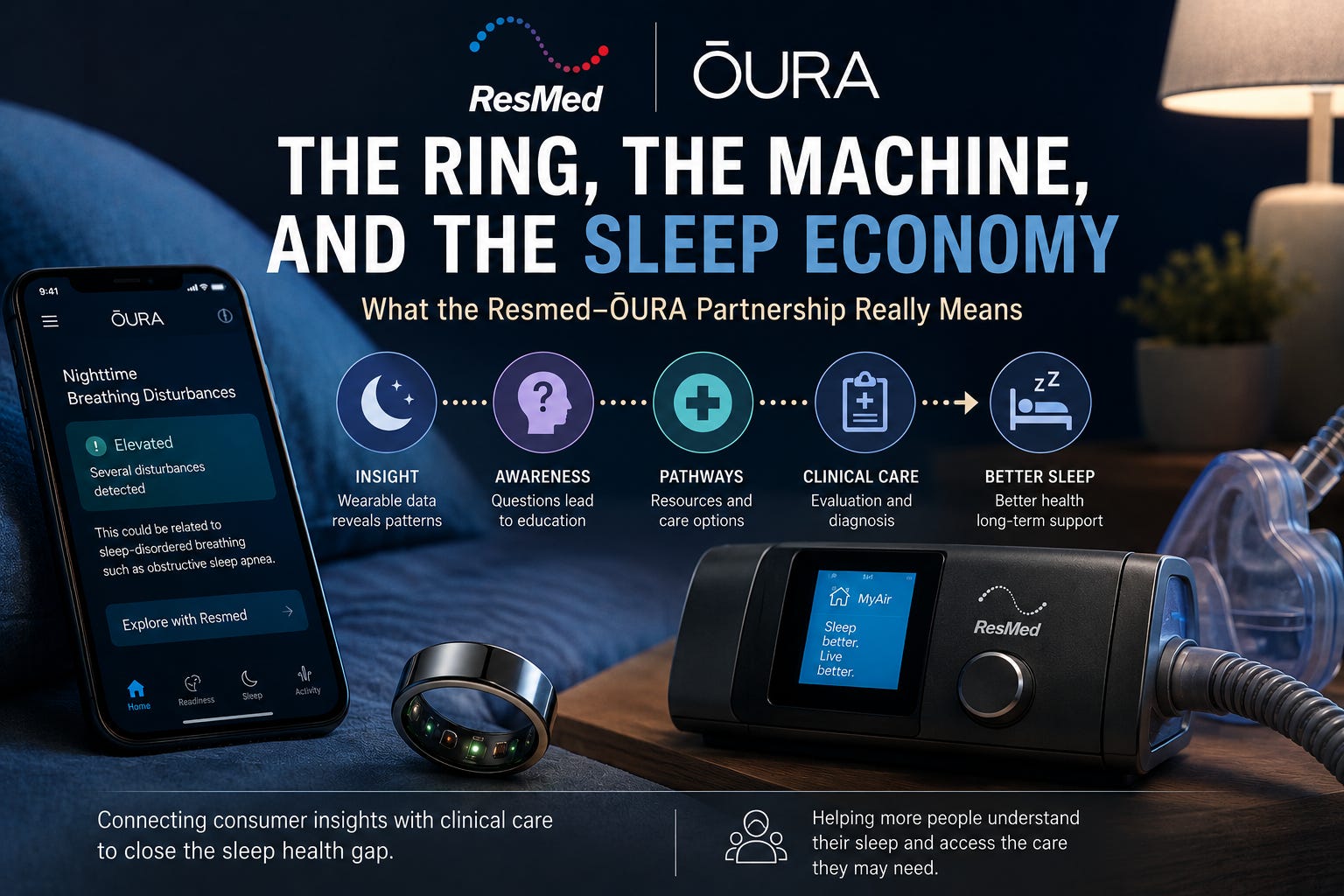
On May 19, Resmed and ŌURA announced a new partnership aimed at “expanding access to sleep health education and pathways to care.” On the surface, this sounds straightforward: wearable sleep tracking meets sleep medicine expertise. But beneath the press release is something much bigger happening in healthcare.
We are watching the official consumerization of sleep medicine.
We’ve been seeing this in clinics for a while now. Patients increasingly arrive not because they’re sleepy or snoring — but because their wearable told them something might be wrong.
It’s increasingly:
“My Oura Ring says my sleep score dropped.”
“My Apple Watch showed sleep stages aren’t perfect.”
“I feel fine, but my wearable says my sleep is fragmented.”
Some of these patients absolutely do have clinically meaningful sleep disorders.
Many do not.
But regardless, wearables are rapidly becoming the new front door to sleep medicine.
Resmed Understands Where the Market Is Going
This partnership makes strategic sense for Resmed.
Resmed has long dominated the PAP therapy ecosystem, but the modern sleep market is shifting upstream. The companies that win the next decade may not simply be the ones that manufacture treatment devices — they may be the ones that capture patient attention before formal diagnosis ever occurs.
That is where wearables come in.
ŌURA has positioned itself as arguably the most sleep-focused mainstream wearable company. Unlike many fitness-first devices, Oura built its identity around sleep, recovery, readiness, and biometrics. The users tend to be health-conscious, affluent, engaged consumers — exactly the type of patients many healthcare companies want entering their ecosystem.
From a business perspective, this partnership is elegant.
A consumer notices nighttime breathing disturbances on their Oura dashboard. They are directed toward Resmed educational content, sleep assessments, and pathways to evaluation. If they ultimately receive a diagnosis of obstructive sleep apnea (highly likely given tests are very sensitive), they can enter the Resmed treatment ecosystem.
This is not merely “education.” This is customer acquisition. And attractive customer acquisition because these patients are often:
commercially insured
digitally engaged
proactive about health
willing to spend money on wellness
likely to adhere to follow-up care and devices
Is Oura Actually Good?
Compared to many consumer wearables, Oura has earned a relatively strong reputation in the sleep world.
It is not a clinical sleep study.
But among consumer-facing devices, Oura has shown reasonably good concordance in several sleep-related metrics compared to formal testing and actigraphy, particularly for:
sleep timing
total sleep time
resting physiology trends
longitudinal sleep pattern tracking
Its limitations remain important:
respiratory event detection is indirect
movement and physiologic inference are not the same as EEG-based sleep measurement
“breathing disturbance” alerts are not equivalent to an apnea-hypopnea index
Still, many clinicians quietly acknowledge that Oura often performs “better than expected” relative to other mainstream wearables.
The Optimistic View
The optimistic interpretation of this partnership is compelling.
For decades, sleep medicine has struggled with underdiagnosis. Millions of patients with obstructive sleep apnea remain unidentified, untreated, and disconnected from care.
Anything that:
increases awareness
reduces stigma
normalizes sleep discussions
nudges patients toward evaluation
improves sleep literacy
could potentially improve public health. And that’s where wearables fit in. They create persistent engagement with sleep metrics in a way that traditional healthcare never has.
In this version of the future:
patients become more informed
sleep disorders are identified earlier
treatment rates improve
cardiovascular risk decreases
sleep becomes viewed as a foundational health pillar alongside exercise and nutrition
That is the vision both companies are selling. And there is probably some truth to it.
The Pessimistic View
But there is another interpretation.
One increasingly familiar to sleep clinicians.
Wearables may also be creating a generation of patients hyper-fixated on sleep metrics, physiologic optimization, and nightly performance scores.
This phenomenon — often referred to as “orthosomnia” — describes patients becoming anxious or dysfunctional because they are trying too hard to achieve “perfect” sleep.
Ironically, obsessing over sleep can worsen sleep itself.
The risk is that consumer sleep tracking can blur the line between:
wellness optimization
disease screening
medical diagnosis
health anxiety
And when a wearable company partners directly with a sleep-device manufacturer, skeptics will understandably ask: Is this about improving sleep health? Or is it about expanding the funnel of future sleep medicine customers?
The answer, of course, is probably both.
Sleep Medicine Is Entering Its Consumer Era
The broader significance of this announcement may have less to do with Oura specifically and more to do with what it represents.
Sleep medicine is no longer confined to office visits and clinicians, it’s now direct to consumer.
Clinicians will increasingly need to:
interpret wearable-generated concerns
contextualize imperfect consumer data
reassure healthy patients appropriately
identify clinically meaningful disease amid noise
avoid overmedicalizing normal sleep variation
At the same time, healthcare companies are recognizing that whoever owns the consumer sleep relationship may ultimately own the downstream care pathway as well.
Resmed clearly understands this. And this partnership likely won’t be the last major wearable-clinical integration we see. The question is whether patients ultimately become healthier — or simply more monitored.
Chris & Robson.