
Sleep Is Big Business
Billions of Dollars in Research and Costs, What Are Patients Getting for It?


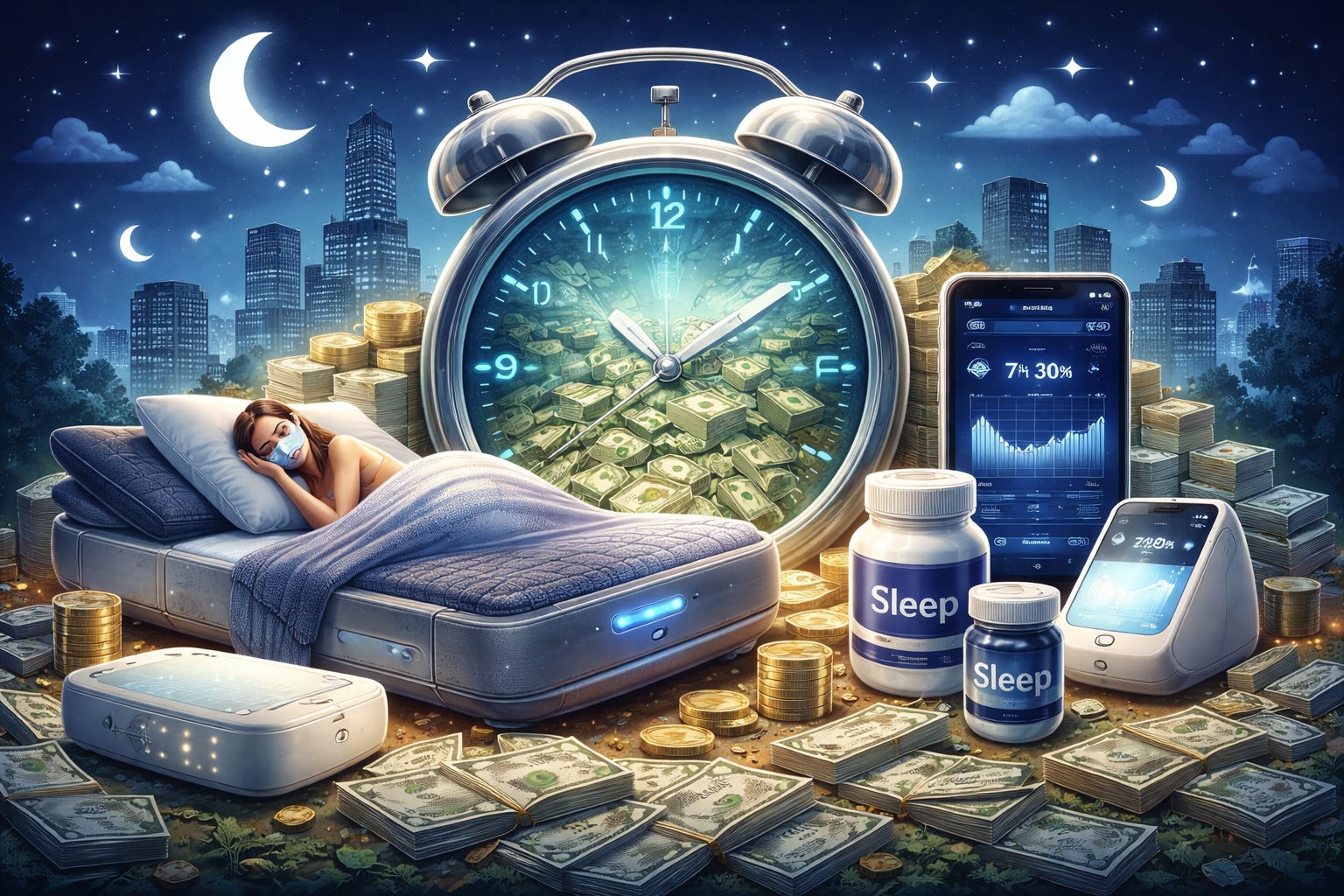
💤 The Global Sleep Market: A Rapidly Growing Health & Tech Ecosystem
Sleep used to be ignored in broader health markets — something only specialists cared about. Today, it’s a multi-billion-dollar global industry, driven by rising sleep disorders, heightened consumer awareness of sleep’s role in health, an influx of digital and AI-enabled technologies, and a growing number of treatment arms. The sleep market is no longer..sleepy.. it’s evolving into a broad health and wellness category poised for sustained growth, and closely followed by financial analysts and venture/tech funds.
📈 Market Size & Growth Forecast
According to a recent publication, The Business Research Company’s Sleep Global Market Report, the sleep industry continues to expand substantially:
In 2024, the global sleep market was valued at approximately $62 billion.
It’s projected to grow to nearly $66 billion in 2025, with a compound annual growth rate (CAGR) of ~6.6%.
By 2029, the market is forecasted to reach ~$84.6 billion at a CAGR of ~6.4%.
This steady growth reflects not just traditional sleep products but a broader convergence of healthcare, consumer tech, and wellness.
The US Chamber of Commerce actually puts this number significantly higher, they estimate ‘sleep tourism’ alone of $400 BILLION.
🧠 What’s Driving the Expansion?
Several key forces are fueling this growth:
1. Rising Prevalence of Sleep Disorders
Sleep disorders like insomnia, sleep apnea, and restless leg syndrome are increasingly recognized around the world. More diagnoses mean more demand for both diagnostic, and therapeutic/support solutions.
2. Greater Public Awareness of Sleep Health
People increasingly connect good sleep with overall health — including mental health, cognitive function, and chronic disease risk — prompting investments in tools that promise better rest.
3. Aging Global Population
With age, sleep disturbances become more common. As the global population ages, demand for diagnostics, therapies, and sleep-enhancing products rises.
4. Digital Health & Home Monitoring Adoption
Wearables, home sleep trackers, and telemedicine platforms are making sleep monitoring more accessible than ever. This trend isn’t just consumer-facing — it’s shifting the way clinicians think about diagnostics and longitudinal data. AI is adding a layer to each of these as well to improve their utility.
🚀 Market Segments: Beyond Pillows & OTC Aids
The sleep industry covers a spectrum of products and services:
Sleep aids (medications, supplements, natural remedies)
Sleep technologies & devices (wearables, smart monitors, AI platforms)
Bedding and comfort products (mattresses, pillows, sleep environment products)
Diagnostics & clinical tools (sleep studies, clinical sleep software)
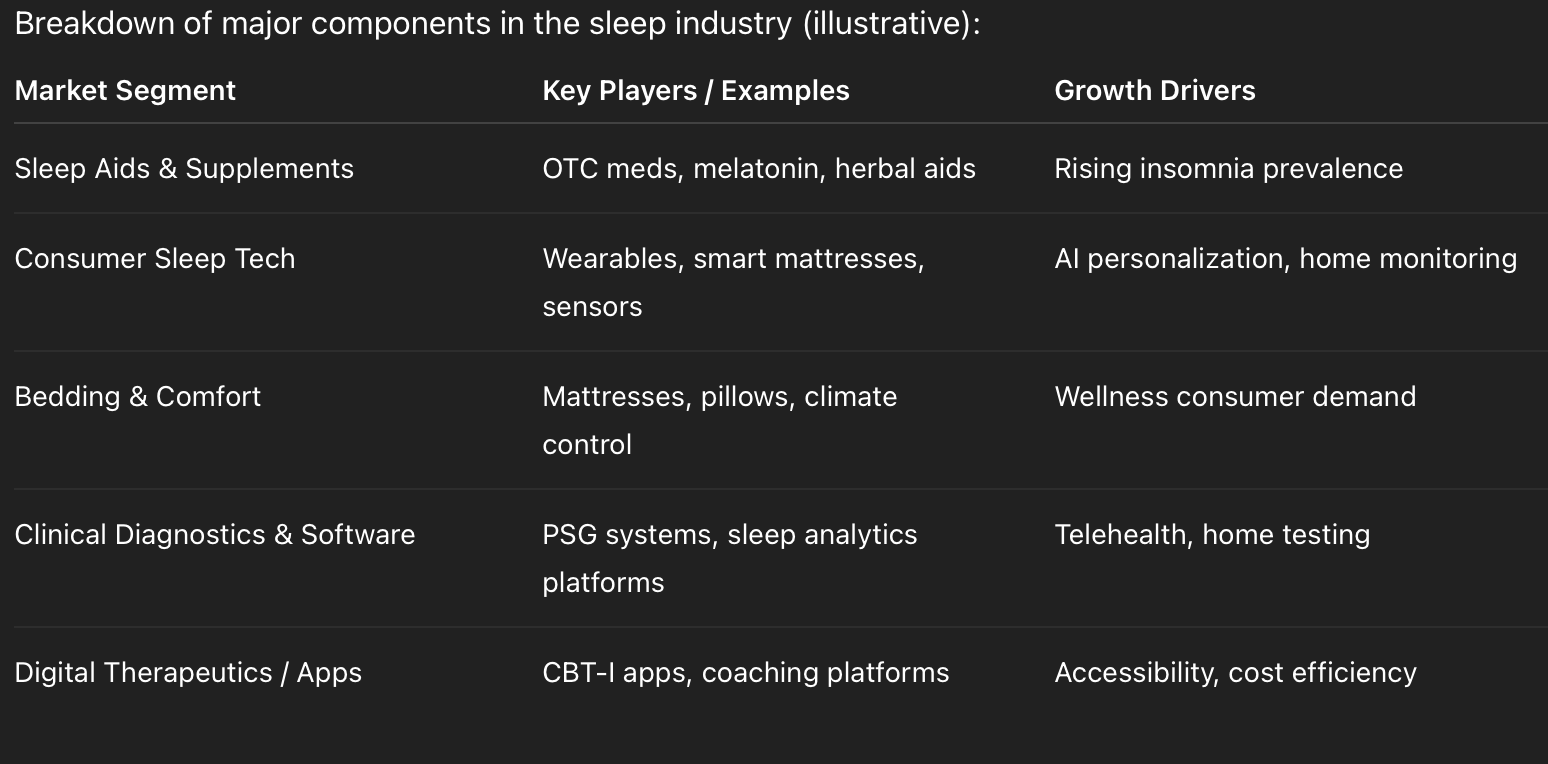
Emerging technologies — particularly AI-driven sleep analytics and smart environments — are becoming central growth drivers as they promise personalization and real-time insights.
Within the clinical sphere, new medications and surgical devices are also being developed (though these are regulated more tightly).
🌍 Regional Trends
North America remains the largest regional market, buoyed by high healthcare spending, advanced tech adoption, and growing consumer awareness.
Asia-Pacific is the fastest-growing region, with expanding healthcare infrastructure and rising demand for sleep health solutions across large populations.

🔍 Sleep Tech & Analytics: A Sector on the Rise
While the broader sleep market includes traditional products, sleep tech — especially smart devices and software — is accelerating rapidly. Independent market analyses show that:
The sleep tech devices segment is expanding even faster than the overall market, with projected double-digit CAGR in many forecasts.
Wearables, contactless monitoring, and AI-enabled diagnostics are cornerstones of this growth.
This tech push is one reason companies like Eight Sleep, Oura, Apple Watch, and others are becoming prominent players in a space once dominated by traditional medical device and bedding companies.
🧩 What This Means for Clinicians & Sleep Specialists
For professionals in sleep medicine and related fields, these market trends signal a few important themes:
1. Demand is High for Advanced Sleep Tools: Growth is happening ahead of validation for the vast majority of these technologies. The ethos is great, but are we actually helping patients?
2. Someone Needs to Translate to the Bedside: Physicians will need to help patients understand what is real, and what is just marketing.
🧠 Conclusion: A Sleep Market Poised for Growth
The global sleep market is more than a $60 billion industry — it’s a fast-evolving ecosystem at the crossroads of healthcare, technology, and consumer wellness. We look forward to evaluating more new products and reviewing the science and real world applications.
Sleep Well, Chris & Robson.
I think it's okay to demand clinical utility from these various companies (which I put in the article). There's a lot of interest in getting money from patients, clinicians should rightfully ask for evidence of QOL/outcome improvement, pretty mixed right now.
Fascinating and a little sobering read. The sleep economy is booming, but the real question is whether all this innovation is translating into better rest for patients or just more data and devices to manage.