


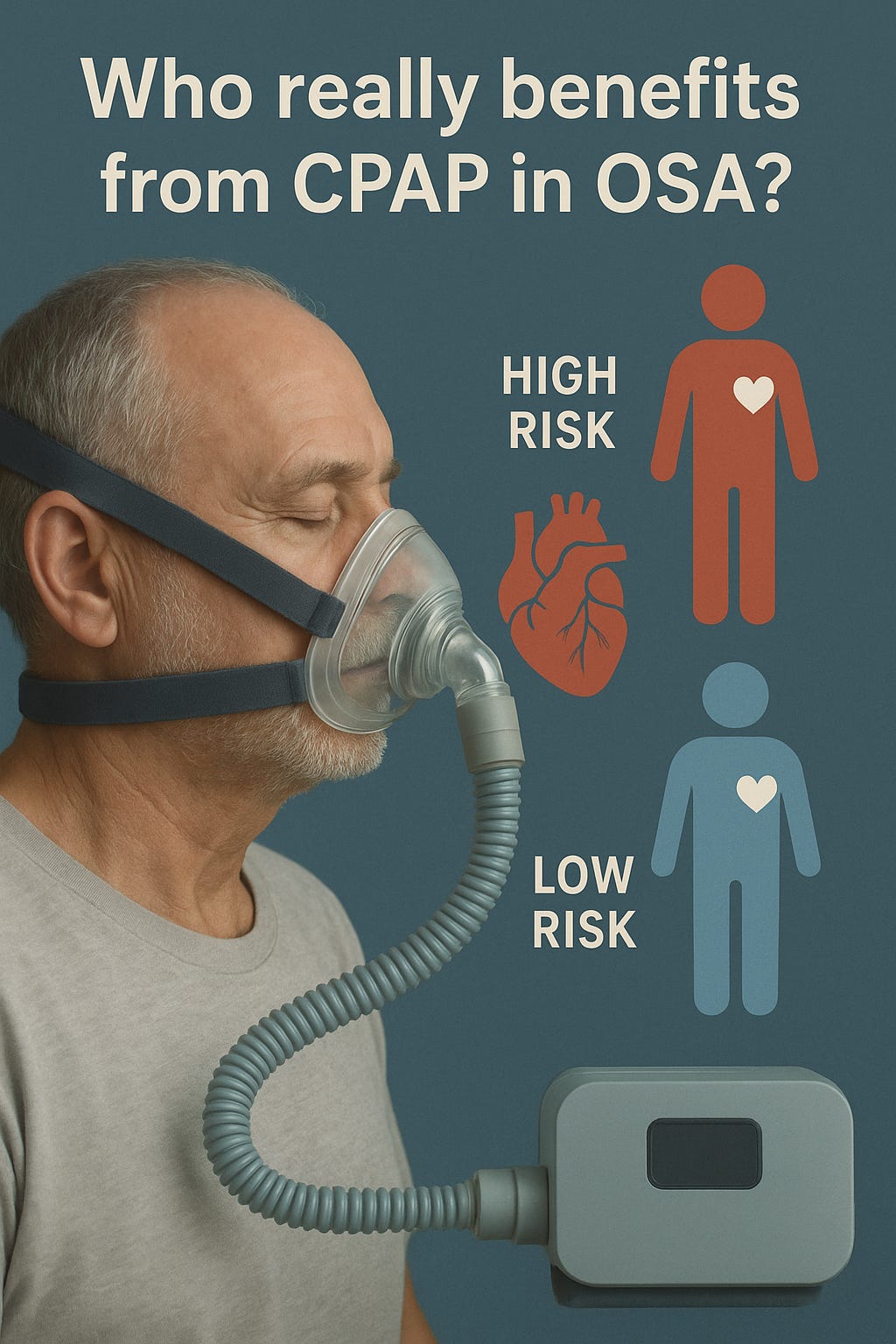
One of the central tenets in sleep medicine has long been that untreated obstructive sleep apnea (OSA) raises the risk of cardiovascular and cerebrovascular disease, including heart attack and stroke. As central, CPAP therapy not only improves symptoms, but also reduces those risks.
Yet, large randomized controlled trials over the past decade have failed to consistently show cardiovascular benefit from CPAP. This has left a meaningful challenge in clinical practice: how essential is CPAP really? There is no doubt that symptomatic, severe sleep apnea patients will draw some benefit, but when it comes to forcing patients without symptoms or less severe OSA to be treated, what is the real health risk?
NEW EVIDENCE
A recent paper in the European Heart Journal (here) offers a more nuanced take on OSA management. The authors hypothesize—and provide supporting evidence—that cardiovascular risk/CPAP-response are not uniform across all patients with OSA. Instead, they cluster into high-risk and low-risk endotypes:
High-risk OSA patients (those with meaningful ‘heart rate response’ following AHI events; and significant ‘hypoxic burden’ by standard metrics) do appear to derive cardiovascular benefit from CPAP therapy.
Low-risk OSA patients, on the other hand, may not benefit—and in fact, the data here suggest the possibility of harm in this population.
This stratified approach makes intuitive sense to many clinicians. Hypoxic burden, in particular, has been recognized as a significant driver for the health-sequelae of severe obstructive sleep apnea.
Interestingly, the paper also showed that benefits were greatest in non-sleepy individuals. The authors hypothesize that non-sleepy patients typically have increased sympathetic-excitation and greater heart rate fluctuations in response to apneas/hypopneas based on previous study as the etiology.
WHY DOES THIS MATTER?
These findings continue a shift in how we frame discussions with patients. OSA is no longer binary yes/no based on one metric (AHI) alone, and treatment decisions are also no longer binary yes/no (CPAP). It is now important to review the whole patient: symptoms, sleep scores, snoring burden and weigh quality of life with the pros/cons of various treatment options.
High-risk patients → Stronger rationale for emphasizing adherence and long-term CPAP use, or considering more invasive surgical (or non) treatments.
Low-risk patients → More thoughtful conversations about goals of therapy, alternative treatments, and weighing the burden of nightly CPAP against uncertain cardiovascular benefit.
As the treatment armamentarium for OSA continues to grow (new surgeries, GLP’s, positional gadgets, Apnimed), this is even more important. We will certainly be citing this study in our practice moving forward.
Would love to hear from others if this fits their own practice, or if they strongly disagree with the framing!
Best, Chris and Robson.
I've been going years with chronic fatigue and didn't know what was the cause. I assumed it was hypothyroidism. The prescription (Levo) for that made way more exhausted so I was told to stop taking it as that extreme fatigue was literally depressing me. I immediately felt loads better after stopping Levo, but I was still unusually fatigued. Finally I had a sleep study ordered and found out I have mild hypopnea. I'm on CPAP and my AHI numbers are low with it.
I was unusually stressed during the same time as the fatigue started, and thought maybe it was PTSD, and perhaps that is some of it, but since going on CPAP (only 3 weeks right now), I have felt a little less stressed. So I'm assuming the hypopnea was stressing me out. I find that interesting since I was only labeled as "mild."
But I totally agree that people should be told about alternative treatments, and should be allowed to try those if it's better for them. I'm interested to see how I feel on CPAP as I go forward. But I'm also using many other alternatives in addition to it (like an Airwaav recovery mouth piece).
Who benefits? Well, the companies! Philips paid out over £1.1.billion in 2024 - https://edition.cnn.com/2024/04/30/health/philips-1-billion-cpap-settlement-agreement
"Medical device maker Philips announced a nearly $1.1 billion personal injury settlement over some of its CPAP, ventilators and BiPAP machines that were at the heart of a massive recall in 2021. The company also agreed to pay $25 million in a medical monitoring settlement. "
I wonder how much their profits are, and I'm sure it suits them all to call CPAP 'the gold standard' whereas around 50% of patients dont manage long term compliance. I think that is not gold at all. Add in health risks of CPAP, and people's desperation - it does work for some as there are few other solutions - ching ching.