
Eight Sleep's $100M Series D Raise
What It Means for Sleep Tech—and Why We Still Need Caution


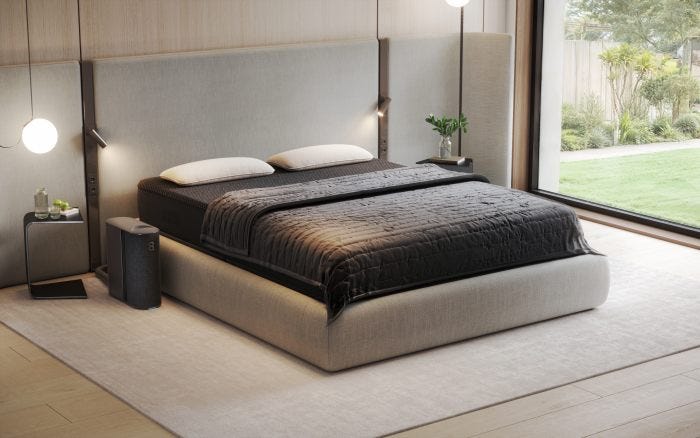
Sleep-tech startup Eight Sleep just raised a $100 million Series D funding round, pushing its valuation to nearly $1 billion and cementing its place as a major player in the sleep-optimization market. The company has positioned itself as the leader in what it calls “sleep fitness,” backed by a scientific advisory board that reads like a wellness all-star roster: Andrew Huberman PhD, Matthew Walker PhD, and Peter Attia MD. Add to that a steady stream of celebrity endorsements and social media influencer campaigns, and Eight Sleep has built a powerful brand halo.
The company’s ambitions are just as bold: expanding into new markets like China, ramping up consumer marketing to widen its user-base, and even pursuing FDA approval in hopes of gaining insurance coverage for sleep apnea and other sleep disorders. It’s an aspirational plan—but does the product live up to the billion-dollar hype?
What's Behind the Pod?
How It Claims to Work
The Eight Sleep Pod is a smart mattress (or cover) capable of dynamic temperature regulation—cooling or heating the bed in real-time—paired with biometric data tracking (heart rate, HRV, respiration, sleep stage estimates). It also has positional therapy built-in with head of bed elevation abilities.
With the new funding, the company aims to supercharge its AI “Sleep Agent” to dynamically evaluate those biometric inputs and adapt temperature, elevation, etc. in real-time.
Scientific Validation to Date
A peer-reviewed, company-sponsored 2024 study found that a week with the Pod ON significantly increased deep sleep (by ~14 minutes, +22%), REM sleep (+9 minutes, +25%), and light sleep (+23 minutes). It also showed improved cardiovascular recovery—heart rate dropped 2%, HRV rose 7%. These were over a couple nights and low sleep times, so fairly limited study, but it fits the generally accepted idea that temperature control is helpful for sleep quality/recovery. PubMed.
Company data (published on their blog) suggests further improvements: 32% better overall sleep quality (via PSQI- sleep survey), 44% faster sleep onset, 23% fewer awakenings, and 34% increased daytime energy after one month. This was a subjective survey after one month of using the device (no control). Eight Sleep.
What Are People Saying? Reviews & Costs
User Experience
Anecdotal reviews are generally positive—much of these are via social media influencers and the above mentioned wellness-podcast ecosystem. Independent voices suggest the same temperature-control features now exist in more affordable competitors—raising questions about value.
Pricing Model
The Pod is expensive: up to $5,099 for a king-size “Ultra” unit, plus an annual app subscription ($200-400); accessories like a hydro-powered blanket cost an additional $1,000. The company markets toward affluent professionals (tech, white collar, medicine)—willing to pay these prices to invest in sleep improvement given the value of their time. The company is also introducing lower-cost supplements and products to broaden appeal.
A Sleep Doc’s Perspective: Excited but Vigilant
We love seeing real investment flowing into sleep health—Eight Sleep’s raise validates that sleep medicine is a serious business and a channel for innovation. But a few cautious notes:
Validation Matters: The science supports what the Pod is doing: improving sleep environment = improved sleep. However, the actual evidence to support its use thus far is small sample, company sponsored, and retrospective. Independent, controlled studies demonstrating the impact of AI-driven, temperature-based interventions, especially on clinically meaningful outcomes like sleep apnea or daytime functioning are needed, especially if pursuing insurance/FDA approvals.
Cost vs. Value: There are other competitors doing cooling/heating bedding significantly more affordable than Eight. Will insurers cover high-cost hardware versus established OSA therapy like CPAP or mandibular advancements? If the Pod reaches medical device status via FDA, this could shift—but ROI will have to be clear.
Real-World Usability: AI is compelling, but it must outperform simple, low-cost interventions (like consistent sleep hygiene or adjusting the AC). We should compare Pod use to traditional optimizations, not just to “no intervention.”
Watch for Orthosomnia: As I’ve discussed before, more data without proper interpretation and guidance is not always better. These affluent, generally healthy, users can often become anxious about otherwise fine sleep by over-tracking scores and metrics—a phenomenon known as “orthosomnia. “
Bottom Line
Eight Sleep’s Series D raise is a major win for sleep health. Their AI roadmap, smart hardware, and biometric tracking suggest potential positive impact. The attention they have garnered through celebrity endorsements and wellness-influencer marketing can lift all efforts to improve patients’ sleep quality.
Still, we must balance enthusiasm with evidence-based discipline. As clinicians—and increasingly as stakeholders in this space—we should continue pushing for robust validation, mindful adoption, and value.
Would love to hear your thoughts—sleep clinicians, medtech investors, or patients readers—what is your experience with Eight Sleep?
— Chris and Robson
Citations:
https://www.wsj.com/articles/musk-and-zuckerberg-praise-this-3-000-smart-mattress-cover-will-regular-people-buy-too-587c41a5?utm_source=chatgpt.com
https://techcrunch.com/2025/08/19/eight-sleep-grabs-100m-to-bring-ai-into-your-bed/
I was gifted one of the price s by the brand a few years ago and it was honestly the worst sleep product i have ever slept on. I didn't realise Attia, Huberman and Walker sat on their advisory board but as 3 of the 4 horsemen of bad sleep it does not surprise me at all.
The product was noisy, took ages to set up and incredibly uncomfortable and the tracking was massively off, giving me and my wife scores in the 90's despite us not sleeping at all. you should never trust a racket in a product as it'll tell you the product works great. I reported my experience to the brand but was told tk try it for longer, which was a non starter after the poor sleep we had already had.
My experience was surprise as all the online reviews talked abkut how great the product is, but then I realised they all had affiliate links and after rooting round on reddit found quite a few people whose experience was similar to mine in terms of customer service and product experience.
Eight sleep talks abkut he operating system for sleep and the thought fills me with dread as if this comes to pass, we are all going to sleep a lot worse.